


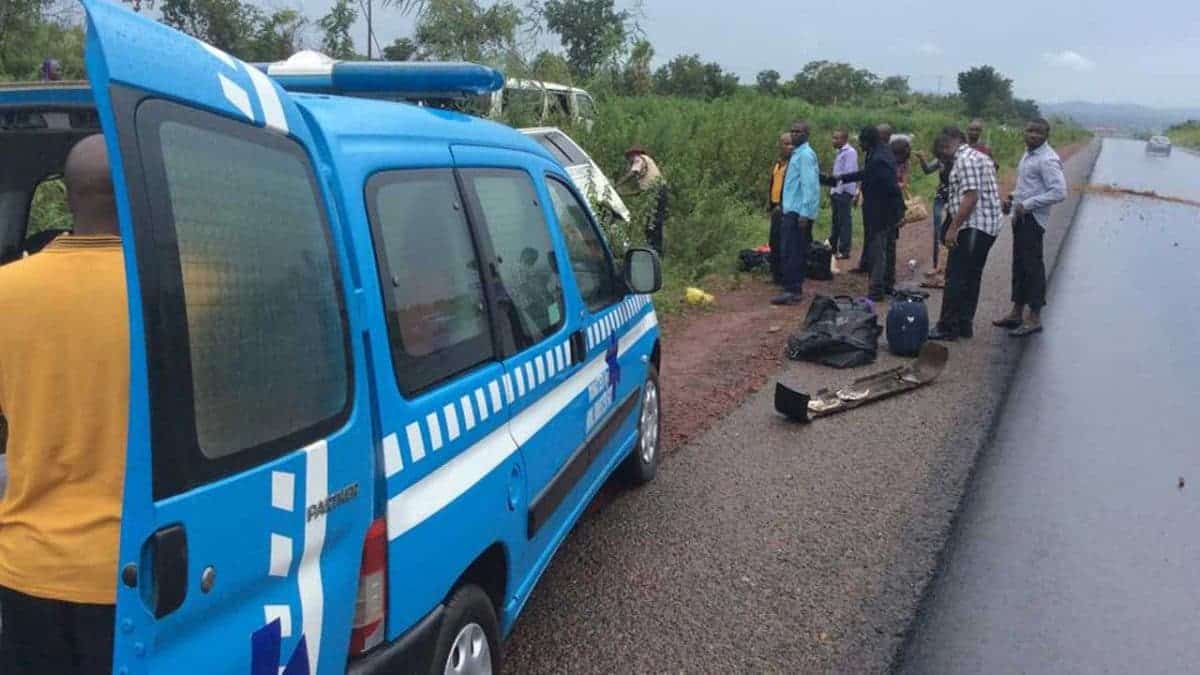
ABEOKUTA, Nigeria – A tragic lone-vehicle accident on the Lagos-Ibadan Expressway has claimed the lives of four individuals and left eight others hospitalised with significant injuries.
The incident, which occurred in the early hours of Sunday morning, has once again cast a sombre light on the persistent dangers of excessive speed and poor vehicle maintenance on one of Nigeria’s busiest arterial roads.
According to official statements released on Monday by the Ogun State Command of the Federal Road Safety Corps (FRSC), the crash took place directly in front of Christopher University.
The location, a well-known stretch of the highway that often invites high speeds due to its relatively smooth surface, became the site of a chaotic scene as a commercial Toyota Hiace bus, registered as AGL 789 YL, veered out of control.
Mr Afolabi Odunsi, the Public Relations Officer for the Ogun State Command, provided a detailed briefing in Abeokuta, confirming that the accident occurred at approximately 1:30 a.m.
At that hour, visibility is naturally reduced, and the highway often sees a mix of heavy-duty haulage trucks and high-speed commercial commuters.
Read also: Many Feared Dead as Loaded Tanker Fell in Abeokuta.
The Toyota Hiace was carrying thirteen passengers at the time of the impact, a group that included eleven adult males and two adult females.
Preliminary investigations conducted by FRSC officials at the scene suggest a lethal combination of mechanical failure and human error.
Odunsi noted that the primary cause of the tragedy was a burst tyre, an event that became unmanageable because the vehicle was travelling well above the recommended speed limit.
The sudden loss of tyre integrity at high velocity made it impossible for the driver to maintain a steady course, leading the bus to somersault or collide with the median, though the specific mechanics of the vehicle’s final rest remain under review.
Emergency responders arrived to find a scene of devastation. Of the thirteen occupants, four were confirmed dead at the site. The remaining eight passengers sustained various degrees of trauma, ranging from fractures to severe lacerations.
In a swift, coordinated effort, the FRSC personnel evacuated the injured survivors to Famobis Hospital, where they are currently receiving medical attention.
Meanwhile, the bodies of the deceased were transported to the Idera morgue for identification and eventual release to their grieving families.
WHAT WE THINK
This latest tragedy underscores a growing concern for safety advocates regarding the “speed culture” prevalent among commercial drivers on the Lagos-Ibadan corridor.
While the Federal Government has made significant strides in rehabilitating the road to improve travel times, the smoother asphalt has inadvertently encouraged drivers to push their vehicles beyond safe limits.
When high speeds are coupled with sub-standard or aged tyres, often referred to locally as “Tokunbo” tyres, the risk of a blowout becomes a mathematical certainty rather than a remote possibility.
Motorists should prioritise routine vehicle inspections, specifically focusing on tyre pressure and tread depth, which are critical when navigating long-distance routes in varying temperatures.
On the other hand, the FRSC has vowed to increase its surveillance and enforcement of speed limits along this specific corridor to ensure that the stretch in front of Christopher University, and others like it, do not claim more lives in the future.
